
Five Questions with Vince Scarfo: Get to Know Your Director of Advocacy & Government Affairs
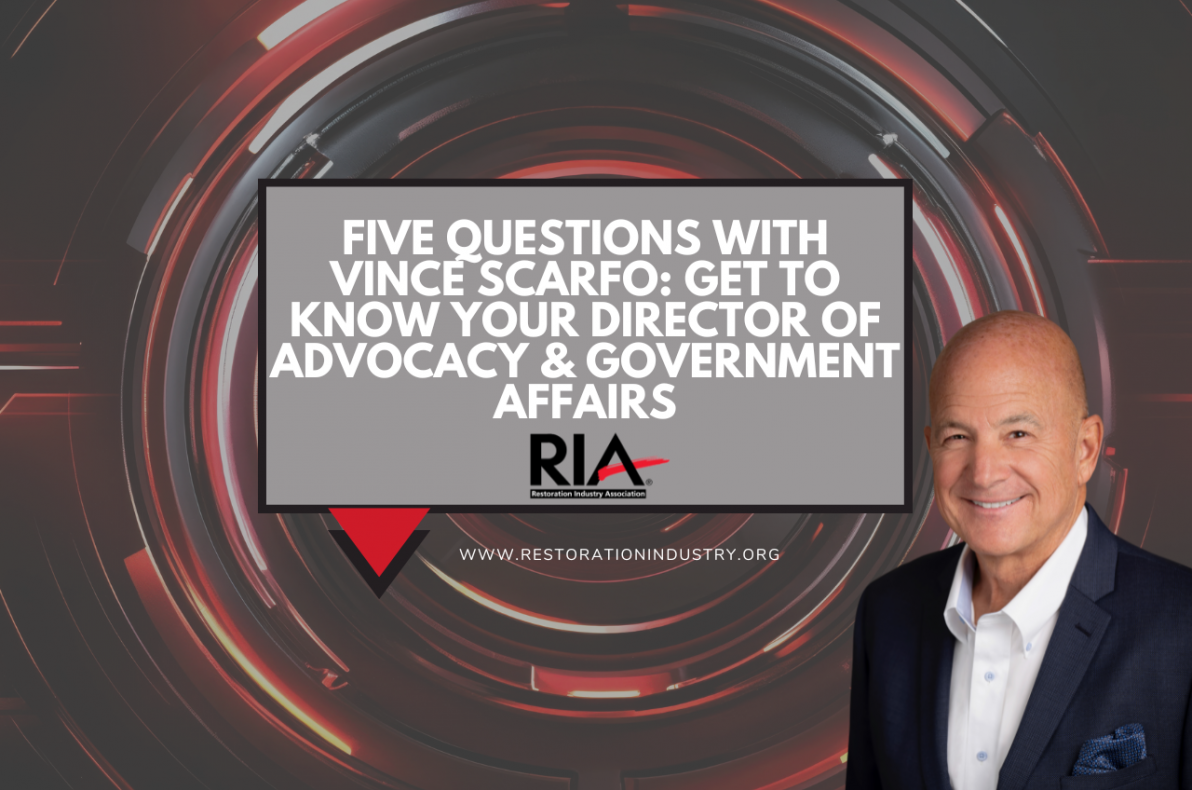
RIA’s advocacy function exists to protect restorers’ ability to perform emergency services, navigate an increasingly complex regulatory environment, and operate without unintended legislative or carrier-driven harm. Vince Scarfo’s role is to anticipate legislative and carrier risk, engage early, mobilize members when needed, and ensure RIA has a credible, consistent voice at the state, federal, and carrier levels—always advocating with the best interests of RIA members at the forefront.
Q1: You’ve spent decades in Fortune 50 companies and then the restoration industry. What drew you to this role with RIA at this moment?
This role is a natural fit for me, the convergence of my career and my purpose. I’ve spent decades working at the intersection of operations, policy, and people, first within large organizations and later in my own companies, and over the last few years alongside restoration professionals who tackle real-world challenges every day.
What truly drew me to RIA at this moment is the opportunity to serve you—the members. RIA is made up of kind, welcoming people who put people first, and that matters a great deal to me. I’ve always found that my greatest sense of fulfillment comes from helping others move to the next level. That might be coaching a child on how to catch a lacrosse ball for the first time, or helping an operations leader understand how to improve efficiencies through a people-first culture.
The setting has changed over the years, but the purpose, people first, hasn’t.
When I read the job description, I knew immediately it aligned with what motivates me. I hoped, fingers crossed, and prayers said, that my experience would earn the trust of the RIA membership. I’m grateful for the opportunity to help elevate both this industry and the communities RIA restorers serve.
Q2: How does your background shape the way you approach advocacy for restoration professionals?
I approach advocacy the same way I’ve approached leadership throughout my career: listen first, respect the work, and execute toward clear outcomes.
My time in large enterprises taught me how policy actually works, and how easily good intentions can turn into unintended consequences when lawmakers and regulators don’t fully understand real-world operations.
It’s not much different from what mitigation teams do every day. No two jobs are the same. You assess the situation, call upon your experience, and execute to achieve the desired result. As conditions change or new information comes to light, you adapt. Advocacy works the same way.
That’s why we must be involved before decisions are rendered.
My experience in the restoration industry has grounded me in realities few industries face: challenging accounts receivable cycles, narrow margins, workforce pressures, and immediate stakeholder friction following a loss. That combination allows me to translate the real world of restoration into language that legislators, regulators, and carriers can understand and respect. When restorers have a voice, better decisions are made.
Q3: Looking ahead, what do you see as RIA’s most important role in shaping the future of the restoration industry?
Carpe Diem. It really might be that simple.
RIA restorers must seize the day, take the torch from the trailblazers who brought us this far, and elevate the industry to the next level.
Legislators, carriers, and other stakeholders are under growing pressure and increasingly recognize that restorers must be part of the solution. It’s our time in the spotlight. Let’s seize it.
This is a call to action. Get a little leaner in your business, yes, even after the challenges of 2024, and join your fellow RIA members in taking action.
Let’s not just have a voice. Let’s be the voice.
To the successful owners, IICRC Triple Masters, P.E. gurus, technology experts, and even knuckleheads like me, let’s join forces, build on the journeys our predecessors created, and take the next hill.
Let’s go.
I don’t know how many times in RIA’s 80-year history an opportunity like this has come along. What I do know is that our peers opened doors for us, and now it’s our turn to step forward. Let’s lead with the highest moral and ethical standards and show what we already know: emergency service restoration providers are among the very best in the business of people helping people.
Q4: How will RIA’s advocacy strategy evolve in the coming years?
Years from now? Honestly, I have dreams, but no crystal ball.
I can tell you what 2026 looks like.
Either RIA members take additional action to educate themselves and engage, or we limp along with a few one-off wins. Right now, engagement is limited, and the advocacy budget reflects where we are in our development.
That said, RIA leadership and the Legislative Task Force delivered two major wins in 2025:
- Applying for RIA’s own NAICS code
- Securing a major win with the National Council of Insurance Legislators (NCOIL) by leading a change to the Storm Chaser Model Legislation that protects restorers
We also achieved several important state-level wins.
In 2026, we’re expanding the value of two advocacy tools launched by RIA at the end of last year: PolicyNote and VoterVoice.
PolicyNote is how I start my day. It’s a legislative tracking and intelligence tool that helps RIA stay ahead of bills, amendments, and regulatory actions across the country—often before they become widely known.
VoterVoice (Our Advocacy Action Hub) makes it easy for RIA members to communicate directly with elected officials and regulators. When an issue matters, members can send timely, coordinated messages using clear, accurate information, without needing to be policy experts.
We’ll be using our Advocacy Action Hub to keep you informed and nudge you to get involved. More to come.
Grassroots Advocacy
RIA’s grassroots program will launch this year, starting in California, Texas, and Florida. Members in these states will help monitor and respond to legislation and regulations that affect how restorers operate, get paid, and serve their communities.
Building on recent advocacy successes and expanded tools like the Advocacy Action Hub, these efforts will amplify the collective voice of RIA restorers, so lawmakers understand real-world impacts before decisions are made.
I’ll also be undertaking several targeted initiatives, including expanded engagement with NCOIL. I’ve already spent time with them in early 2026, and we’re building deeper relationships to maximize our impact with lawmakers directly involved in our industry.
Bottom line: we need you. Please get involved—in some way, somehow. We are stronger together.
Q5: What does legislative success look like for RIA and its members five years from now?
Success means RIA members operate in a cleaner, fairer environment, where laws recognize the realities of emergency services, standards reflect modern practices, and carriers engage restorers as professional partners.
It means RIA is the first call policymakers make when they need insight into property restoration. It means when disasters strike, restorers are recognized for the essential work they do and welcomed as part of the solution.
Most importantly, it means RIA members did the hard work, not just in moments of crisis, but every day through leadership, guidance, and advocacy.
If restorers can focus more on serving policyholders and less on navigating uncertainty, RIA will have done its job well.
Stay Connected & Support Advocacy
Follow us on social media to stay engaged with the latest updates and advocacy wins. Ready to get involved or support the mission? Email info@restorationindustry.org to learn how you can participate and support the RIA's advocacy efforts.