
Cash vs. Accrual
By Mark Annis
Introduction - Scenario
Open last month's P&L. You probably already know what it's going to say.
The storm hit. Every truck was rolling, crews were pulling sixty-hour weeks, and you couldn't take another call. The P&L says you lost money.
Two months later, the checks come in. The sun's out, the phones are quiet, crews are looking for work. That P&L statement shows a profit.
Your books aren't wrong. But if you're on cash basis, your P&L only counts money when it hits the bank, and not when the work happened. So it tells you your busiest month was a loss and your slowest month was a win. That makes it harder to pay your people on gross profit, hire admin help, plan for another truck and crew, or answer your banker's questions with confidence. And if you're ever sitting across from a buyer, it's the difference between your number and theirs.
Cash vs. accrual accounting is one of the topics the RIA addresses in its updated Accounting and Financial Management Guidelines, released this summer. In this article, we'll dig deeper into the difference, how it shows up on your financials, how to pick the one that's right for you, and the tax implications of each.
Cash vs. Accrual: Follow the Money, or Follow the Work
At its core, each accounting method answers a fundamentally different question:
- Cash Basis: When did money exchange hands? Income is recorded when the customer pays, and expense is recorded when you pay the vendor.
- Accrual Basis: When was the work performed? Income and expense are recorded when you did the work, even if there’s a customer or vendor payment delay.
The difference is best explained with an example. Take a $10,000 mitigation job:
- Month 1: Job performed and completed, $2,000 deposit collected, $3,000 in employee labor cost paid
- Month 2: $3,000 sub cost paid
- Month 3: $8,000 balance payment received from insurance
Cash basis records money only when it moves:
Month 1 | Month 2 | Month 3 | Total | |
Revenue | $2,000 | $0 | $8,000 | $10,000 |
Expense | $3,000 | $3,000 | $0 | $6,000 |
Net | -$1,000 | -$3,000 | +$8,000 | +$4,000 |
Two straight months that look like losses, followed by a month that looks like your best of the quarter, even though the job was done and profitable back in month 1.
Accrual basis records revenue and expense in the month the work happened, regardless of when cash moves. The job was completed in month 1, so that's where the full picture lands:
Month 1 | Month 2 | Month 3 | Total | |
Revenue | $10,000 | $0 | $0 | $10,000 |
Expense | $6,000 | $0 | $0 | $6,000 |
Net | +$4,000 | $0 | $0 | +$4,000 |
Same job, same $10,000 in revenue, same $6,000 in cost, same $4,000 profit. The only thing that changed is when the P&L shows it.
Accrual, Refined: Invoice Date vs. Percent Complete
Accrual answers "when was the work performed,” but on a job that runs for weeks or months, performed still has to be measured somehow, and there are two common ways to do it.
Accrual (invoice date) is what most accounting software, including QuickBooks, uses by default. Revenue is recognized when you send the invoice, expense when you receive the bill. On a short job, it’s pretty straightforward, as the invoice usually goes out close to when the work wraps up.
Accrual + WIP (percent complete) measures revenue against actual job progress - costs incurred against the total estimated cost of the job - instead of relying on when someone got around to billing it. It's the method most relevant to reconstruction work, where a job can be well underway long before the billing catches up.
Expanding on the example used in the Know Your Numbers webinar with Anthony Nelson: a $120,000 job, split evenly across two months of work: 50% complete in month 1, 100% complete in month 2, with payment received in month 4. Here's what that looks like across cash, accrual, and accrual + WIP:
- Month 1: $40,000 in costs incurred and paid, $20,000 billed, job 50% complete
- Month 2: remaining $40,000 in costs incurred and paid, job 100% complete, remaining $100,000 billed
- Month 3: no activity - waiting on the carrier
- Month 4: full $120,000 payment received
Cash basis:
Month 1 | Month 2 | Month 3 | Month 4 | Total | |
Revenue | $0 | $0 | $0 | $120,000 | $120,000 |
Expense | $40,000 | $40,000 | $0 | $0 | $80,000 |
Net | -$40,000 | -$40,000 | $0 | +$120,000 | +$40,000 |
Accrual (invoice date):
Month 1 | Month 2 | Month 3 | Month 4 | Total | |
Revenue | $20,000 | $100,000 | $0 | $0 | $120,000 |
Expense | $40,000 | $40,000 | $0 | $0 | $80,000 |
Net | -$20,000 | +$60,000 | $0 | $0 | +$40,000 |
Under the accrual (invoice date) method, the collection lag is gone, but month 1 still looks like a loss and month 2 like an outsized win. This is because billing happened to lag behind progress and then catch up all at once.
Accrual + WIP (percent complete):
Month 1 | Month 2 | Month 3 | Month 4 | Total | |
% complete (cumulative) | 50% | 100% | 100% | 100% | — |
Revenue earned | $60,000 | $60,000 | $0 | $0 | $120,000 |
Expense | $40,000 | $40,000 | $0 | $0 | $80,000 |
Net | +$20,000 | +$20,000 | $0 | $0 | +$40,000 |
This method shows $20K in profit each month when work was actually performed.
All three methods land on the same $40,000 in profit across multiple months. What changes is whether the P&L tells that story evenly, or in a sequence of false losses and false wins that has nothing to do with how the job went.
So What?
It's one thing to understand the mechanics. The most important question is why it matters for your business.
Both accrual and accrual + WIP accounting methods reflect gross profit closer to actual business activity, not just when cash happens to hit your bank account. Doing this gives you several real advantages:
- You can structure incentives off it. If you have line GMs or PMs, you can pay them on the profit their line actually produced, not job-level guesswork or sales volume. In a margin-compressed environment, having your team incentivized on profit instead of sales is a real edge, and you can't build that comp plan on a number that swings with payment timing.
- It's easier to talk to your bank. Bankers are used to accrual accounting. It lets you talk about your ability to service debt in terms of what your business actually generates, not when cash happened to land in the account last month.
- You know what you can actually afford. Whether an office hire, a truck, another crew, a cash-basis month that looks better or worse than it really was can talk you into a decision you can't support, or out of one you can.
- You get a real number when you sell. Walk into a sale with your own accrual numbers, and you're presenting the business's actual performance. Walk in on cash basis, and you're letting the buyer's team normalize your books on their terms, which usually means their number, not yours.
- You spot problems faster. Pricing and expense issues show up in the month they happen, not many months later when the cash finally catches up.
The Real-World Impact Across a Full Year
Take a restoration company doing about $3M a year and ~13% net income, a steady base of mitigation and water jobs running all year. We’ll assume two major events: a storm that hits in March, and three major fire rebuilds that start in August.
The chart below shows net income under two methods, month by month. The baseline mitigation work keeps every month solidly positive under both methods - this isn't a business that swings between loss and profit. What swings is how each method treats the two events layered on top of it.
During the storm, cash basis drops below baseline in March and April, then spikes well above it in May and June once payments are finally received. Accrual + WIP does the opposite - it rises in March and April, right when the crews are actually doing the work, then settles back to baseline once the job is done and paid. The fire rebuilds tell a similar story in the fall.
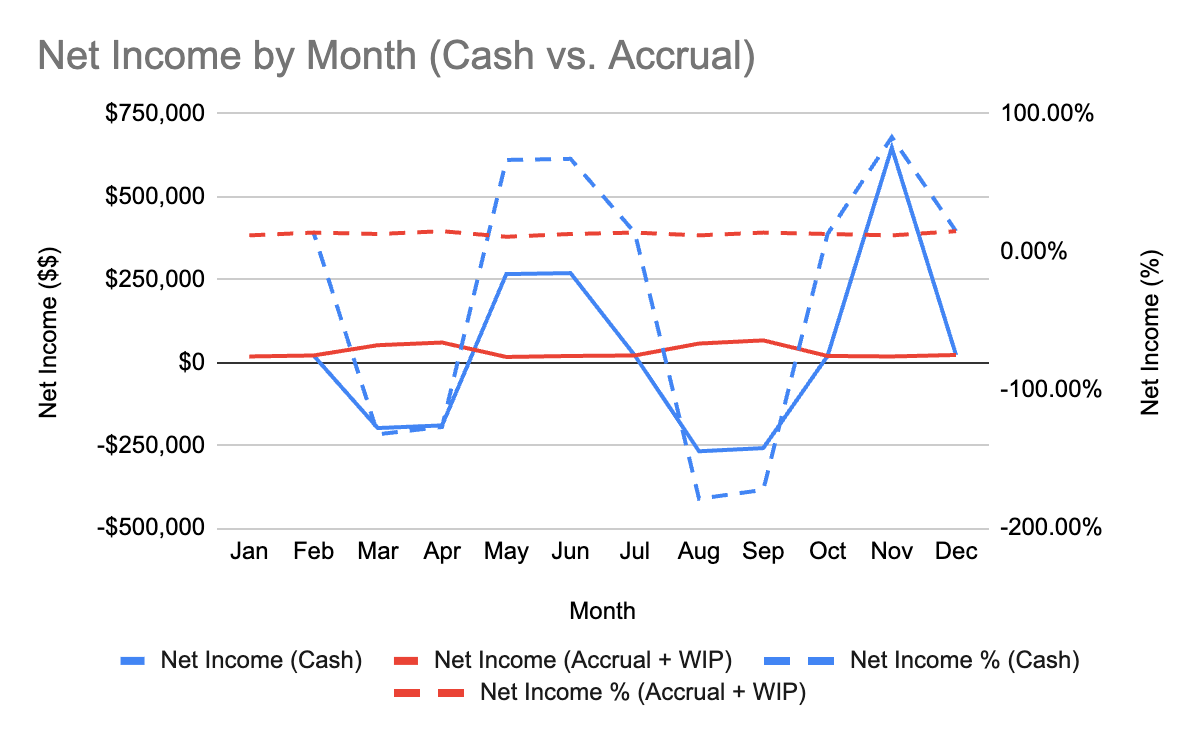
Both methods arrive at virtually the same full-year net income, landing within 3% of each other, and neither is "wrong." Accrual + WIP finishes slightly higher simply because it captures work earned on the fall fire rebuilds that remained unbilled and uncollected as of December 31st.
Now let's answer the questions from earlier - but picture yourself standing in March, or August, with only one of these numbers in front of you:
Operational Question | Cash Basis | Accrual + WIP |
Pay PM incentives off it? | No. Swings with carrier payment timing. | Yes. Ties bonuses to margin earned that month. |
Afford equipment or debt? | No. P&Ls look artificially feast or famine. | Yes. Shows steady monthly margin bankers can underwrite. |
Valuation-ready to sell? | No. Buyers will recast your numbers. | Yes. Buyer-ready numbers keep you in control of the deal. |
Spot problems faster? | No. Moves track carrier timing and job ramp-up, not the business itself. | Yes. Shows your true expected margin every month, so a dip actually flags a job or operational problem |
Which Method Is Best?
There's no one right answer. It depends on what your business looks like and what you need the number for.
Cash basis works fine if you're mostly doing mitigation, your business is steady, and you're not seeing big swings in payment timing, or if you don't take insurance work at all. It's also a reasonable call if you're smaller and the extra accounting work of running accrual just doesn't pay for itself yet.
Accrual works fine if you're mostly mitigation with very limited reconstruction, since payment timing tends to smooth out over time. You’ll still feel some whiplash around a big storm event because it’s less precise, but it can work.
Accrual + WIP becomes important once reconstruction is a real part of your business, or your jobs start running long enough that billing and progress can drift apart for months at a time. That's when the gap between "what accrual shows" and "how the money’s flowing" gets big enough to matter.
What About Cash Flow?
Cash flow matters a lot. You can't pay your bills with gross profit. None of this is an argument against watching cash closely, and you should be doing a cash flow projection regardless of which method you use to run your P&L.
But cash flow and profitability answer two different questions:
- Cash flow asks: Can we pay our bills on time?
- Accrual accounting asks: Is the business generating a healthy, consistent profit?
You need both answers, and neither one substitutes for the other.
This is why running accrual doesn't stop you from protecting your cash - it gives you the clarity to do both. For instance, some owners use accrual margins to track a project manager's performance during the job, but hold final bonus payouts until the project is closed and 100% collected. Accrual books don't force you into bad cash habits; they simply give you the control to align incentives deliberately rather than being trapped by cash timing because it's the only number you have.
Taxes
There's a good chance you're already filing on cash basis for tax purposes, and that's fine, even if you run accrual books to manage the business.
The IRS lets most businesses elect cash or accrual for tax purposes up to a gross receipts threshold ($32 million for 2026, adjusted for inflation each year). Below that, you can generally choose whichever method suits you for tax filing, regardless of how you keep your books internally.
That means you can run two sets of numbers: cash basis for taxes, and accrual (or accrual + WIP) for managing the business. Your tax CPA can help you set this up, as reconciling cash to accrual at year-end is a normal part of what they already do for clients. The two aren't in conflict; one is for the IRS, the other is for you.
Final Thoughts
At the end of the day, your P&L should be a tool that guides your decisions, not a source of confusion after a busy storm season. You can still manage cash flow carefully and file your taxes on a cash basis, without letting cash timing blindfold you to your operational reality.
By moving toward accrual accounting and tracking work as it happens, you take control of your numbers. And when you own your numbers, you own the decisions that drive your growth, your profitability, and your company's future.