
Knowing Your Numbers: Using Your Monthly Breakeven Point to Navigate Success

Insights provided by Mark Annis.
It’s mid-June, the weather is dry, and the shop phone hasn’t rung in four days. Yet on the first of the month, $30,000 in warehouse rent, van leases, and payroll still hit your bank account like clockwork. You're left staring at the calendar, wondering how many water calls you actually need to land before the end of the month just to get back to zero.
Or maybe you’re facing the opposite trap: your crews are pulling 14-hour days grinding through Third-Party Administrator (TPA) work. Your trucks are rolling and your drying gear is deployed, but the margins are lower, and you’re left wondering if those jobs are actually paying the bills or just burning out your team.
Navigating both dilemmas comes down to making smart operational trade-offs, and your breakeven point is one particularly useful metric to guide those decisions. In short, the breakeven point is the baseline number of calls required to cover every shop bill, van lease, and crew paycheck before you make a single dollar of profit for yourself.
In this article, we’ll break down how to calculate your real number, avoid the common accounting traps unique to restoration, and use that target to make smarter operational choices.
The Baseline: Fixed vs. Variable Costs
At its core, your breakeven point answers one fundamental question: How many jobs do we need to run this month to start earning our first dollar of profit? Finding that target requires splitting your business expenses into two clear categories: fixed and variable.
Fixed costs are the recurring expenses you owe every month whether or not any jobs come in. Because these costs stay steady over a 6- to 12-month period, they form the baseline overhead floor your business must clear. In addition to warehouse rent, van leases, insurance, and software, this category includes all of your full-time staff: office managers, sales reps, project managers, and core lead techs who stay on payroll to ensure 24/7 readiness.
Variable costs go up or down directly with every job. You only incur these expenses when you actively take on work and put crews on a job site. In restoration, the primary variable costs come down to a few major drivers: job materials and consumables, subcontractor fees, and any overtime or part-time help brought in to handle surge volume.
The Math in Action: A 1-Month Restoration P&L
Let’s look at a simple example of a $1MM shop doing water mitigation with an average ticket size of $6,000 (14 jobs per month, totaling $84,000 in monthly revenue).
Line Item | Amount |
|---|---|
Revenue | $84,000 |
Materials & Consumables | $4,200 |
Subcontractors & Overtime | $12,600 |
Full-Time Techs | $25,200 |
Gross Profit | $42,000 (53%) |
SG&A – Office, Sales, Rent, etc. | $24,000 |
Net Income | $18,000 |
Materials and Consumables ($4,200) and Subcontractors & Overtime ($12,600) are variable costs tied directly to job production. Conversely, Full-Time Techs ($25,200) count as a fixed cost for this breakeven calculation because payroll runs whether jobs are on the schedule or not. SG&A is also fixed, as overhead remains constant regardless of job volume.
A practical note on sourcing your numbers: When running this calculation, do not simply assume that expenses above the Gross Profit line are variable and everything below it is fixed. In practice, many operators park job materials, consumables, or unassigned field labor in general overhead below the line to simplify bookkeeping. This will result in a break-even target that is lower than reality.
Pulling Your Baseline Numbers
Using the P&L above, we pull out the two core totals needed to run the breakeven math:
- Total Fixed Costs: $24,000 (SG&A Overhead) + $25,200 (Full-Time Tech Readiness Payroll) = $49,200 / month
- Variable Cost Per Job: $16,800 ($4,200 Materials + $12,600 Subs/Overtime) ÷ 14 Jobs = $1,200 / job
Doing the Math: Solving for Your Monthly Job Target
Now that we have fixed and variable expenses broken out, the next step is to calculate your breakeven point. We start with the basic profit formula every business owner knows:
Profit = Revenue - Expenses
When we break expenses down into their variable and fixed components, the equation expands to:
Profit = (# Jobs x Average Ticket) - (# Jobs x Variable Cost per Job) - Fixed Costs
At breakeven, profit equals zero (Profit = 0). Plugging in the numbers from our $1MM shop example: a $6,000 average ticket, $1,200 in variable costs per job, and $49,200 in total monthly fixed costs, the math looks like this:
0 = (# Jobs x $6,000) - (# Jobs x $1,200) - $49,200
Now, we solve for # Jobs in three straightforward steps:
1. Combine the job-level cash flow
Subtract the $1,200 direct job costs from the $6,000 ticket to see what each call actually leaves behind.
0 = # Jobs ($6,000 - $1,200) - $49,200
0 = (# Jobs x $4,800) - $49,200
2. Isolate the overhead floor
Move the fixed costs to the other side to balance the equation.
(# Jobs x $4,800) = $49,200
3. Divide to solve for # Jobs
# Jobs = $49,200 / $4,800 = 10.25 jobs
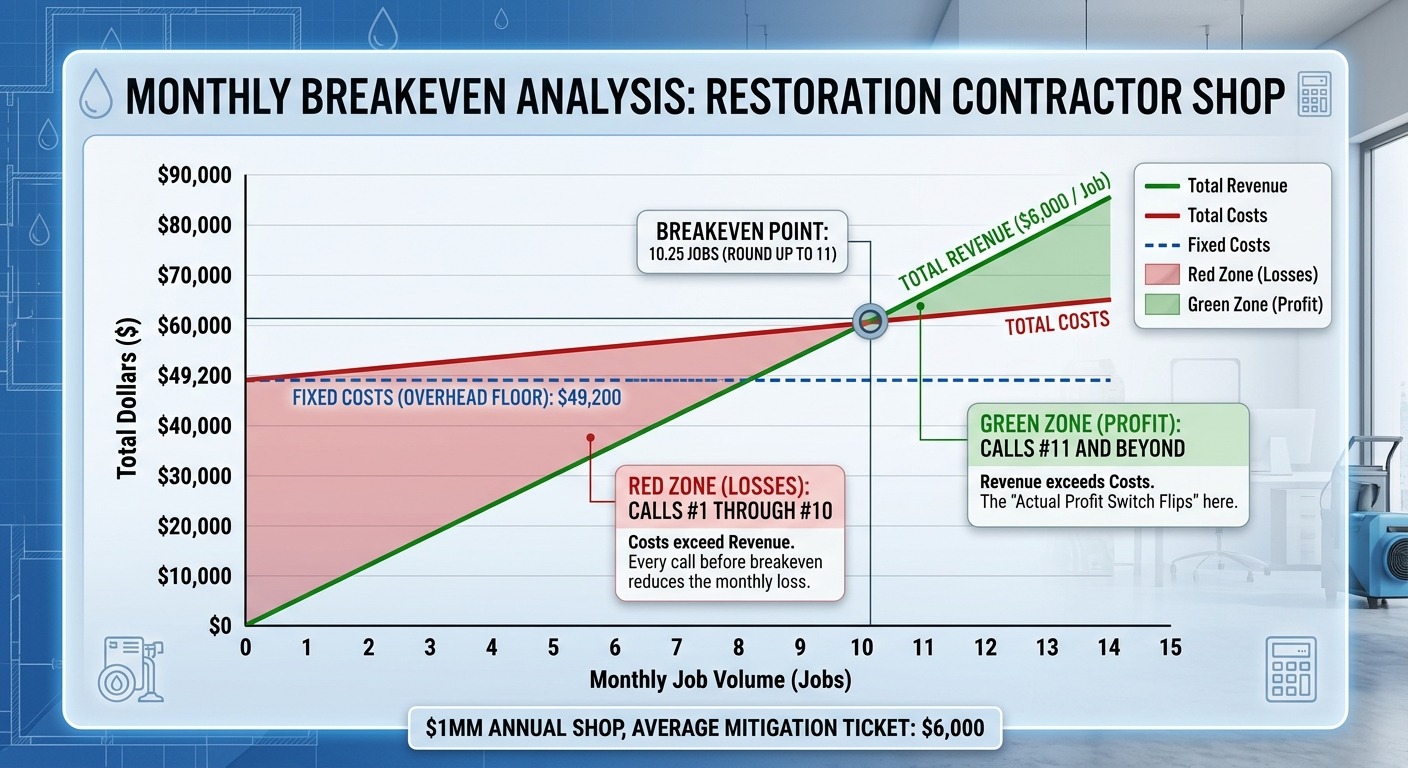
Rounding up to the nearest whole truck roll, you need 11 jobs every month just to bring your bank account back to zero. Calls 1 through 10 pay off your shop floor, van leases, and core crew; call #11 clears the remaining balance; and call #12 is where your actual profit switch flips.
Visualization of the Breakeven Point
Here is a visual breakdown of this $1MM shop example:
Why This Number Matters: Two Real-World Scenarios
Imagine it’s mid-July and you are sitting at just 4 completed jobs for the month. On the 1st of the month, your $49,200 in fixed overhead hit your bank account like clockwork. Because you know your breakeven target is 11 jobs, you know you are still 7 calls short of getting back to zero. You face a clear choice: either wait around for the phone to ring and take a massive cash loss, or spend $1,500 on targeted digital ads and plumber outreach to secure those final calls. Knowing your numbers makes pushing for the aggressive marketing option a no-brainer. You aren't guessing whether spending extra money mid-month makes sense because you know it is the exact lever required to cover your shop floor and protect your cash flow.
Now flip the script. It’s late in the month and you have already hit 15 jobs. Your fixed overhead is 100% paid off, your core team is maxed out, and every new dollar can contribute to your bottom line - assuming your team has capacity (see section “Operational Reality: Overcapacity Creates Profit Leaks”). A low-margin TPA job comes across your desk, but because your internal crew is fully booked, taking it means relying almost entirely on subcontractors and temporary labor. Without knowing your breakeven, you might take the job just to chase top-line revenue. But because you know your overhead is already fully covered for the month, passing on the work becomes an easy call. And you might lose money if your overextended team makes errors. You don't need to stretch your bandwidth for scrap profits when your shop floor is already paid for.
Operational Reality: Overcapacity Creates Profit Leaks
In theory, any revenue past your breakeven point drops straight to the bottom line (less direct variable costs). In reality, every job demands administrative management, carrier compliance, and project oversight. Even if your team's base salaries are fully covered, overextending a maxed-out crew causes critical details to slip—such as missed 24-hour TPA photo logs, unbilled equipment days, or scope errors. On thin-margin work, those small operational slip-ups quickly flip a projected paper profit into an active net cash loss.
Conclusion
The math we walked through here is an intentional simplification. It doesn't account for multi-trade service lines, and it assumes your fixed overhead stays completely frozen while your realization percentage never slips. Breakeven is ultimately just one data point in your toolbox, not the end-all-be-all. You simply can't run a restoration shop on breakeven analysis alone when cash flow timing, collection speed, and crew utilization still dictate your long-term survival.
But perfection isn't the goal - clarity is. It serves as a critical baseline, and it gives you an immediate, practical answer to the single fundamental question every operator asks when staring at the calendar: Have we at least covered our costs?